
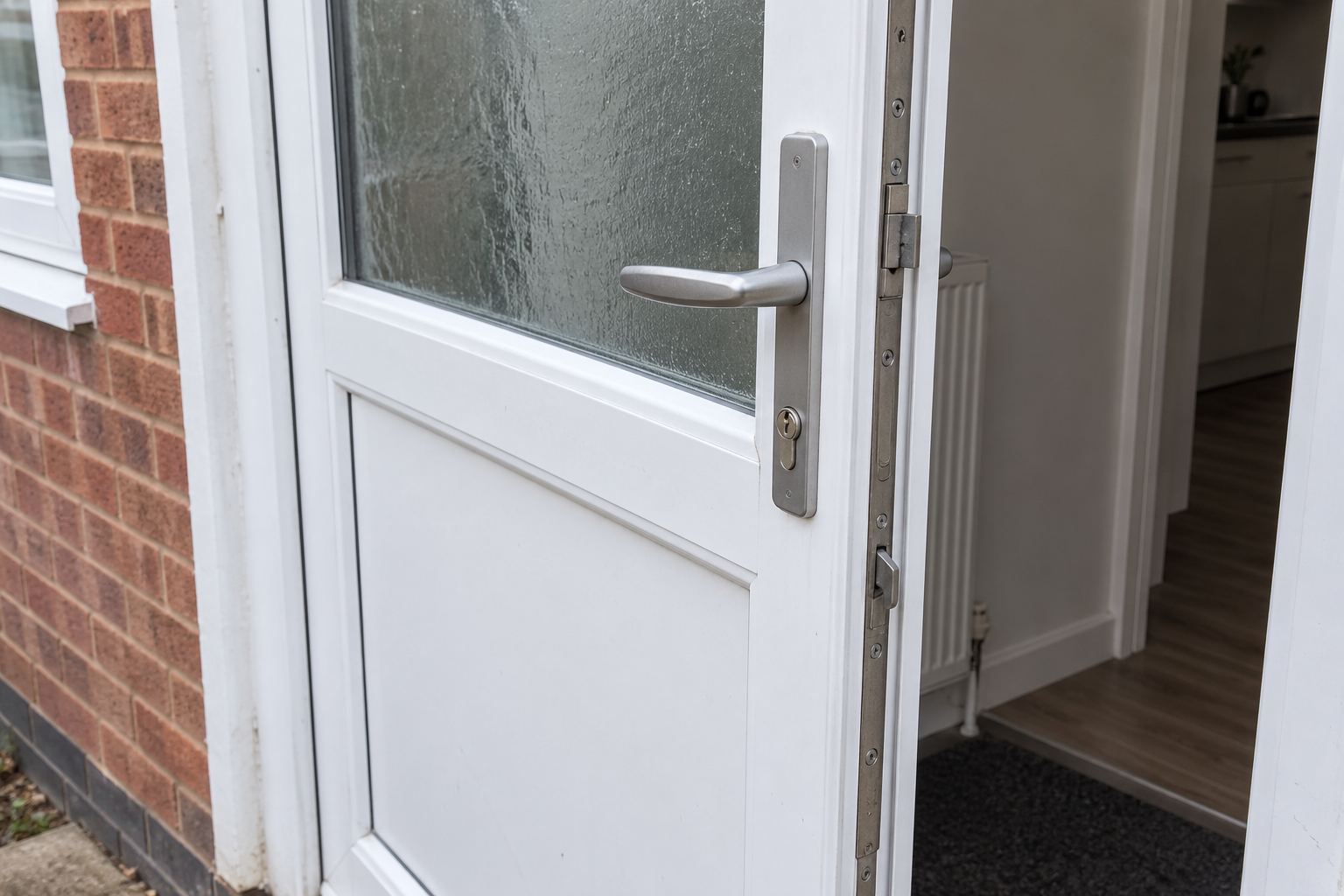
An anti-snap lock is a euro cylinder that has been designed and tested to stop a burglar breaking it in two and opening your door. To know you’ve got a proper one, look for one of two marks on the cylinder: the TS007 Kitemark with three stars, or Sold Secure Diamond (SS312). Either one is the level West Yorkshire Police tell homeowners to aim for.
The word “anti-snap” on a packet isn’t the same thing. Here’s what the marks mean, how to check your own door, and why fitting matters as much as the lock.
What lock snapping actually is
Most uPVC and composite front doors, and plenty of patio and French doors, are locked by a euro cylinder. That’s the part you put your key in, sitting in the middle of the handle. Lock snapping means using force to break that cylinder in two (Master Locksmiths Association). Once the front half has gone, the mechanism behind it is exposed and the door can be opened.
It isn’t a rare trick. West Yorkshire Police advice puts attacks on euro-cylinder locks at roughly 20 to 25% of all burglaries in West Yorkshire. The same advice notes that in around 40% of those attempts the burglar doesn’t get fully in. In other words, the cylinder in your door makes a real difference.
TS007 stars: what 1, 2 and 3 stars mean
TS007 is a standard developed by Secured by Design (the police crime prevention initiative), the Door & Hardware Federation and the Glass & Glazing Federation (Door & Hardware Federation). Products that pass carry the Kitemark plus a star rating.
- 1-star cylinder: tested, but not anti-snap when it’s fitted on its own.
- 2-star handle or lock surround: security door furniture that shields the cylinder.
- 3-star cylinder: attack-tested, and protects the door on its own whatever handle it sits in.
The stars add up. Your door reaches the recommended level in one of two ways:
- A TS007 3-star cylinder, or
- A TS007 1-star cylinder combined with a TS007 2-star handle or lock surround.
Fit a 3-star cylinder and a 2-star handle together and you get the maximum the TS007 system offers, which West Yorkshire Police describe as 5 stars. Their advice is that a 3-star cylinder is the preferred option, because it gives the lock itself the most protection.
One catch worth repeating: the Door & Hardware Federation says the cylinder must carry the TS007 Kitemark together with three stars. A 1-star cylinder in an ordinary handle is not anti-snap, whatever the box says.
What is Sold Secure Diamond (SS312)?
Sold Secure is a separate testing scheme. Its cylinder specification, SS312, has two main grades: Gold and Diamond. According to the Master Locksmiths Association, Diamond is the highest grade a cylinder can achieve and is treated as equivalent to a 3-star Kitemarked cylinder for building regulations. Gold is the equivalent of 1-star, so it should be paired with an approved handle or surround.
At the moment, the Diamond grade only applies to euro profile cylinders, which are the type found on most uPVC and composite doors.
TS007 3-star vs Diamond: which should you choose?
Straight answer: either. West Yorkshire Police advice recommends cylinders rated TS007 3-star or Sold Secure Diamond, and doesn’t rank one over the other.
The difference is in how they’re tested. The Master Locksmiths Association explains that the Diamond test uses a much heavier tool list, with slightly less time allowed, and that the general view in the trade is that Diamond is the harder test to pass. Some cylinders carry both marks.
What matters more than which badge you pick:
- The cylinder genuinely carries one of the two marks.
- It’s the right size for your door.
- It’s fitted properly and sits flush.
It’s also worth checking your home insurance. The Master Locksmiths Association notes that some insurers specifically ask for an SS312 Diamond cylinder, so read your policy before you buy.
How to check what’s on your door now
You don’t need any tools for this. Open the door and look at the outside face of the cylinder, the end with the keyhole.
- Look for markings. An approved cylinder has them stamped on the face: the Kitemark and stars, or the Sold Secure Diamond logo.
- No markings at all usually means a basic cylinder that hasn’t been tested to either standard.
- One star only? Check the handle as well. If it doesn’t carry a TS007 2-star mark, the door isn’t at the recommended level.
- Check how far it sticks out. West Yorkshire Police say cylinders shouldn’t be left protruding from the door or handle. If you can get your fingers round the end of it, so can a burglar.
If you can’t make out the markings, take a clear photo of the cylinder face and the handle and send it to us on WhatsApp. We’ll tell you what you’ve got.
Fitting matters as much as the lock
A Diamond-rated cylinder that’s the wrong size is a waste of good money. Euro cylinders are measured from the central fixing screw out to each end, and the two sides are often different lengths. West Yorkshire Police advice stresses measuring properly so the new cylinder is right for your door.
Too long and it sticks out past the handle, giving someone something to grip. Too short and it may not work the mechanism properly. Either way, you’ve paid for a security upgrade you’re not getting.
The same police advice also suggests sash jammers as an extra layer on doors. They’re a simple bolt-on device and worth considering on back and side doors that aren’t overlooked.
Should you upgrade?
If the cylinder on your front or back door has no markings, or only one star in a standard handle, then yes. West Yorkshire Police advice is to upgrade any euro cylinder that hasn’t achieved a 3-star TS007 rating or Sold Secure Diamond.
The good news is that swapping a cylinder is usually a quick job. It doesn’t normally mean touching the rest of the mechanism or the handle, and you get new keys at the same time. If your front door is uPVC or composite, as so many are round Batley and Dewsbury, it very likely has a euro cylinder that can be upgraded the same way.
If you’ve also got a handle that feels loose or a door you have to shove to lock, sort that at the same time. Our guide to a floppy uPVC door handle explains what’s usually behind it.
Need a hand?
We can check what’s on your doors and fit a properly sized TS007 3-star or Sold Secure Diamond cylinder anywhere in West Yorkshire. There’s no call-out charge, the price is agreed before any work starts and every job comes with a 12-month guarantee. Have a look at our anti-snap lock fitting, ring 07977 127 676, or WhatsApp a photo of your lock to the same number for straight advice.