
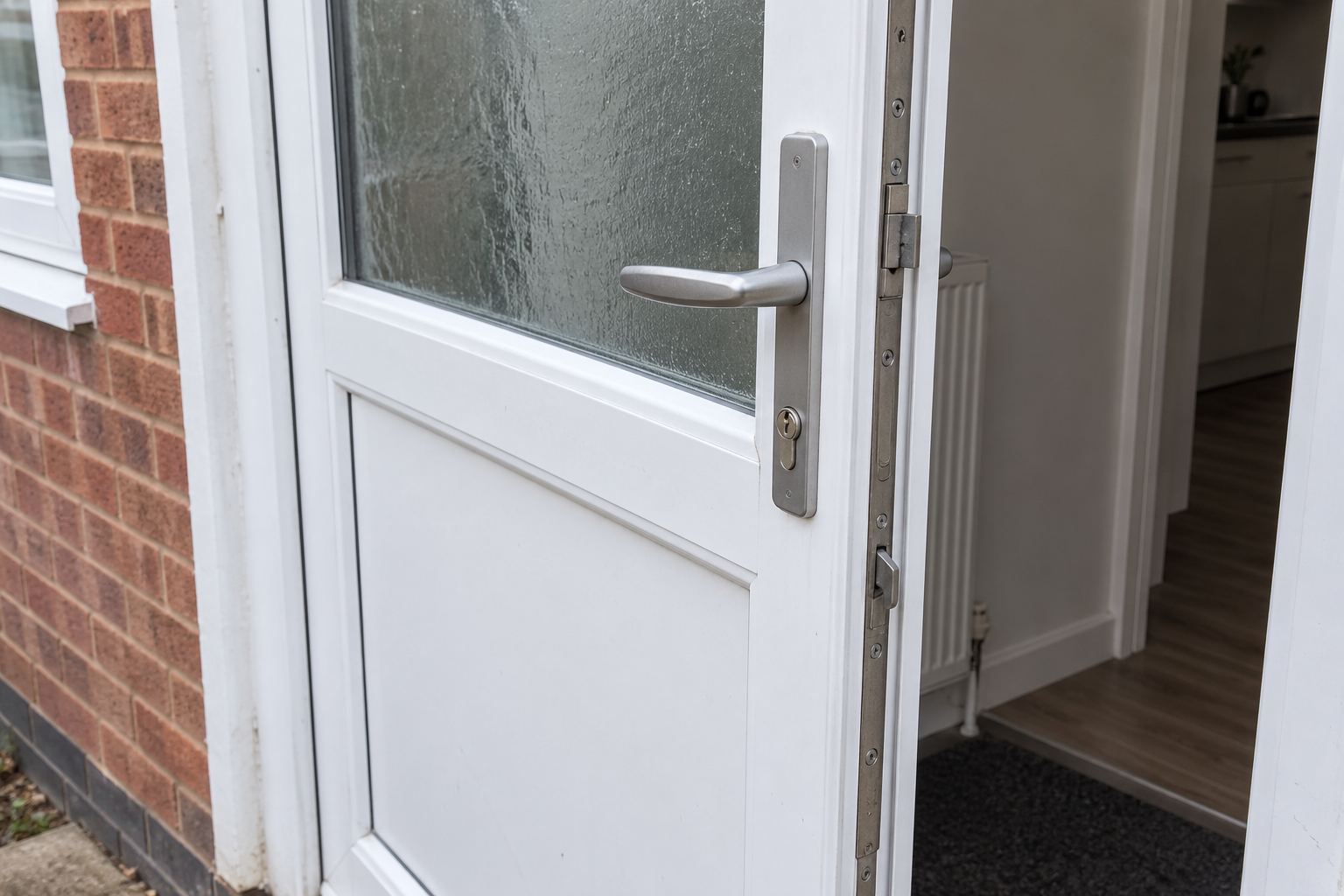
A floppy uPVC door handle is usually down to a worn or broken gearbox inside the door, or a broken spring in the handle itself. If the handle only lifts partway, or the door only locks when you shove it, the door has usually dropped out of line with the frame. Most of these problems are fixed with an adjustment or a replacement part, not a new door.
Here’s how to work out which one you’ve got, what’s safe to check yourself, and why it’s worth sorting sooner rather than later.
How a uPVC door locks, in plain terms
Almost every uPVC door has a multipoint lock. It’s a long metal strip running down the edge of the door with hooks, rollers or bolts along it. In the middle, behind the handle, is the gearbox, which turns the movement of your handle into movement along the whole strip.
When you lift the handle, the locking points shoot out into the keeps (the metal plates on the frame). When you turn the key, it locks them there. So there are three parts that commonly cause trouble: the handle, the gearbox and the way the door lines up with the frame.
Handle floppy when the door is open
If the handle hangs loose or flops down even with the door open, the most likely culprit is the gearbox. The Master Locksmiths Association says a floppy handle with the door open usually means the gearbox is wearing out or has broken down inside, and a replacement gearbox will be needed.
Don’t ignore it. A gearbox that’s on its way out can fail completely, and the same source notes that a door stuck shut with a loose handle is also a gearbox failure. That’s a harder job than swapping it while the door still opens.
Handle droops but the door still locks
Sometimes the handle sags rather than the door refusing to work. The springs that hold a uPVC handle level live inside the handle in a small spring cassette. When that breaks, the handle droops. The Master Locksmiths Association lists a broken spring cassette in the handle as one of the main causes of a loose handle, along with handles that were fitted without all their parts or were the wrong specification for the door.
This is often the kinder version of the problem. If the locking points still go in and out properly when you lift the handle, it may be the handle that needs replacing rather than anything inside the door. It’s not always obvious from the outside, though, which is why a photo or a quick look helps.
Handle won’t lift, or lifts partway and stops
This is where alignment comes in. The Master Locksmiths Association breaks it down like this:
- Lifts easily when the door’s open, but not when it’s shut: usually means the door needs adjusting.
- Lifts partway, stops, and the key won’t turn fully: the door has become misaligned. Left alone, this can end up with the gearbox failing.
- Won’t lift when the door’s open: often a lack of lubrication.
- Won’t push down or lift at all: most commonly a failed gearbox.
Doors drop over time. Hinges settle, the door sags slightly, and the hooks no longer meet the keeps cleanly. You then need more force on the handle to lock it, and that extra force is what wears the gearbox out.
Door only locks if you slam it or push it hard
Same story. If you have to lean on the door or slam it before the handle will lift, the locking points aren’t lining up with the keeps. It’s easy to live with this for months. It works, until one day it doesn’t, and the gearbox gives up with the door either open or locked.
Key won’t turn
First, check the handle is lifted all the way. On a multipoint door the key usually only turns once the handle has fully engaged the locking points. If the handle is up and the key still won’t go, it’s usually alignment, a worn cylinder or a mechanism fault.
Whatever you do, don’t force it. Forcing a key can snap it in the cylinder or damage the mechanism, and it turns a simple repair into a bigger one.
What you can safely check yourself
You can rule a few things out before you ring anyone:
- Open the door and lift the handle. Watch the edge of the door. Do the hooks and bolts all move out smoothly and fully?
- Close the door and try again. If it’s noticeably harder shut than open, think alignment rather than a broken part.
- Look at the frame keeps. Fresh scrape marks around them suggest the locking points are catching.
- Check the handle screws on the inside. If they’re loose, tightening them can stop a handle wobbling, though it won’t fix a broken spring.
- Lubricate the moving parts on the locking strip with a light lubricant if the handle is just stiff with the door open.
And a few things not to do:
- Don’t force the handle or the key.
- Don’t leave a door you can’t lock properly overnight if you can help it.
- Don’t take the mechanism out of the door unless you know exactly which part you’re replacing. Gearboxes and strips vary by make, and getting the wrong one is an expensive guess.
Repair, don’t replace
This is the part people are most relieved to hear. A failed handle, gearbox or cylinder doesn’t mean a new door. According to the Master Locksmiths Association, a handle that won’t lift up or down shouldn’t normally need a new handle, and a gearbox is usually replaced rather than repaired because that’s quicker. Only occasionally does the whole multipoint strip need changing.
A proper repair should finish with the door being adjusted so it closes and locks without a fight. If it doesn’t, the new part will wear out the same way the old one did.
It’s also a good moment to look at the cylinder. If yours has no security markings, it’s worth upgrading while the door is being worked on anyway. Our guide to anti-snap locks explains what to look for.
Why it pays to sort it early
A floppy handle or a door you have to slam is an early warning. Deal with it now and it’s often an adjustment or a single part. Leave it, and the usual ending is a gearbox that fails completely, sometimes with the door locked shut. That’s a bigger job and usually happens at the worst possible time.
Whether you’re in Batley, Dewsbury or elsewhere in West Yorkshire, the first step is the same: send a photo of the door edge, the handle and the lock.
Need a hand?
We repair and replace uPVC door and window mechanisms across West Yorkshire, 24 hours a day. WhatsApp a photo to 07977 127 676 and we can often tell you what’s failed before we come out. There’s no call-out charge, the price is agreed before work starts and every repair comes with a 12-month guarantee. Find out more about our uPVC lock repairs or ring 07977 127 676.